
MotherShipology: Was Leadership Ever Exclusively a Man's Domain?
An Investigation into the Divine Foundation of Leadership
By Rev. Dr. Aminata Njeri
Author • Ruachologist • Pastor • Leaderologist
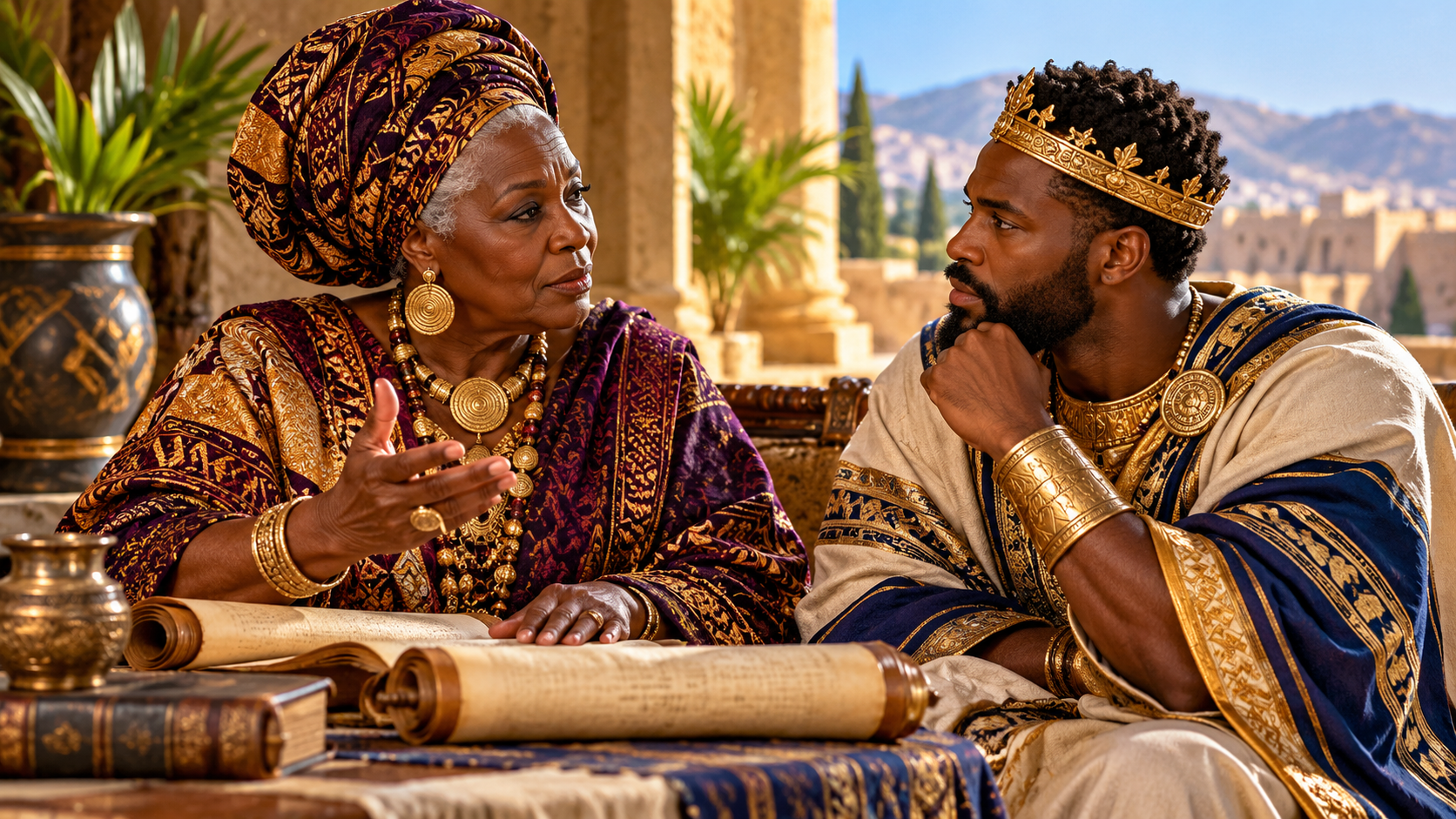
A mother advising her son the King.
Before There Was a King, There Was a Mother
Throughout history, leadership has been associated primarily with men. Kings ruled nations, priests exercised religious authority, and fathers were recognized as heads of households. Over time, these arrangements helped establish the belief that leadership was naturally a man's responsibility.
But was it?
Before accepting that conclusion, consider something interesting in Proverbs 31:1:
“The words of king Lemuel, the prophecy that his mother taught him.” — KJV
Here we have a king receiving instruction from his mother. Not instruction about cooking, cleaning, or managing a household, but instruction about leadership.
In verses 8 and 9, she teaches him to speak for those who cannot speak for themselves, to judge righteously, and to defend the poor and needy.
Isn't that interesting? The king holds the position of authority, but his mother is teaching him how to exercise it.
If leadership involves guiding others, developing their judgment, teaching responsibility, and preparing them to make decisions, then what exactly was King Lemuel's mother doing?
Perhaps the question is not whether mothers have exercised leadership, but why their leadership has so often gone unrecognized.
And if we want to investigate where leadership actually began, we must go back even further than Proverbs.
We must return to Genesis.
Let Us Make: The Divine Joint Venture
Genesis 1:26 records:
“And God said, Let us make man in our image, after our likeness: and let them have dominion...” — KJV
There are several things worth examining in this verse, beginning with the Hebrew word translated as God: Elohim.
Elohim is plural in grammatical form, although it commonly takes singular verbs when referring to the God of Israel. However, in Genesis 1:26, we encounter something particularly interesting. God speaks using plural pronouns.
“Let us make man in our image.”
Who is included in this divine conversation?
Some interpretations suggest that God is addressing a heavenly council. Christian tradition commonly understands the passage in relation to the Trinity. Ruachology examines the possibility that the divine conversation reflects the cooperative activity of the Godhead, including Ruach haKodesh, Mother Holy Spirit.
But before attempting to identify everyone included in the word Us, perhaps we should examine what God intended to create.
The verse continues:
“Let us make man in our image, after our likeness.”
If the purpose was to create humanity in the divine image, wouldn't the description of that humanity be important to understanding what the image represents?
The following verse provides an interesting detail.
Male and Female: The Image of God
Genesis 1:27 states:
“So God created man in his own image, in the image of God created he him; male and female created he them.” — KJV
Notice that the verse does not stop with the creation of man.
It specifically identifies male and female.
Both are included in the description of humanity created in God's image.
Now consider the relationship between these two verses.
In verse 26, God says, “Let us make man in our image.”
In verse 27, the resulting creation is described as male and female.
If both male and female are created in the divine image, why has that image so often been represented almost exclusively through masculine identity?
Could the creation of male and female provide insight into the fullness of the divine image?
This question becomes particularly important when investigating the identity of Ruach haKodesh as Mother Holy Spirit.
The presence of male and female in the divine image does not, by itself, identify the individual persons of the Godhead. Nevertheless, it raises a question worth examining: Has the traditional emphasis on masculine descriptions of God limited our consideration of the feminine within the Divine?
And there is another detail in these verses that deserves attention.
Plural in Identity, United in Function
Genesis 1:26 uses plural pronouns: “Let us make.”
Yet Genesis 1:27 uses a singular Hebrew verb to describe God's creative action.
The Hebrew verb vayyivra, translated as “and created,” is singular.
Why does the passage move from plural divine speech to singular creative action?
Grammatically, the singular verb agrees with Elohim as the singular subject referring to God. But the relationship between the plural speech and singular action also invites theological reflection.
Within Ruachology, this relationship is examined as a possible expression of a divine principle:
Plural in identity, united in function.
In other words, distinction within the Godhead need not imply division in divine purpose or action.
Now consider the human creation described in the same passage.
Male and female are distinct, yet both share the divine image.
They are different, yet they receive a common responsibility.
Could this be an earthly reflection of divine cooperation?
Rather than establishing one as superior and the other as subordinate, the creation account presents male and female as participants in a shared assignment.
A joint venture, if you will.
And the next verse makes that assignment unmistakably clear.
God Blessed Them
Genesis 1:28 begins:
“And God blessed them, and God said unto them, Be fruitful, and multiply, and replenish the earth, and subdue it: and have dominion...” — KJV
Who received the blessing?
Them.
Who received the instruction?
Them.
Who was given dominion?
Them.
There is no separate commission assigning leadership over creation exclusively to the male.
Nor does this verse instruct the male to exercise dominion over the female.
Instead, both receive responsibility for the world they have been placed within.
If leadership involves accepting responsibility, exercising judgment, managing resources, and working toward a common purpose, then both male and female were included in the original leadership assignment.
How, then, did leadership become so closely identified with men that women would eventually have to defend their right to exercise it?
Some may point to later biblical passages describing male authority. Those passages deserve their own examination. But should later descriptions of human relationships cause us to overlook what Genesis 1 says about the original commission?
Perhaps we have been asking the wrong question.
Rather than asking whether women should be permitted to lead, shouldn't we first ask whether leadership was ever assigned exclusively to men?
MotherShip: Leadership Without a Title
Consider what happens when a child enters the world.
Someone must assume responsibility for that child's survival, protection, growth, and development.
The child must be nurtured, guided, corrected, taught, and eventually prepared to exercise increasing independence.
Traditionally, much of this responsibility has been associated with mothering.
Yet these same activities are recognized as essential leadership functions in nearly every other setting.
When an executive develops the abilities of employees, it is called leadership development.
When a teacher guides students toward independent thinking, it is called education.
When a mentor helps another person recognize and develop potential, it is called empowerment.
But when a mother performs these functions, why are they so often regarded as ordinary domestic responsibilities rather than leadership?
Does the absence of an official title make the responsibility any less significant?
Does leadership become leadership only when someone receives a salary, occupies an office, or exercises institutional authority?
These questions introduce MotherShip, the foundational principle that bringing forth, nurturing, protecting, guiding, and developing life represents a fundamental expression of leadership.
MotherShipology is the systematic study of this principle and its implications for understanding leadership.
This does not suggest that leadership belongs exclusively to biological mothers, or that every child's earliest caregiver is a mother. The principles associated with mothering can be exercised by fathers, grandparents, guardians, teachers, and others.
The investigation concerns the leadership model represented by mothering and why its significance has so often been overlooked.
But MotherShipology also raises a theological question.
If mothering provides a foundational human expression of leadership, could there be a divine model from which its principles originate?
Mother Holy Spirit: The Divine Foundation
In John 3:5, Yeshua tells Nicodemus:
“Except a man be born of water and of the Spirit, he cannot enter into the kingdom of God.” — KJV
The language is particularly interesting.
Yeshua does not merely speak of being instructed, influenced, or inspired by the Spirit.
He speaks of being born of the Spirit.
Birth is the means by which life comes forth. While both father and mother contribute to conception, it is the mother who gives birth.
If Yeshua describes spiritual life as being born of the Spirit, shouldn't the maternal significance of that language receive serious consideration?
Traditionally, the Holy Spirit has been presented as the third person of the Trinity and commonly referred to with masculine pronouns. Yet the Hebrew word ruach, meaning spirit, wind, or breath, is grammatically feminine.
Grammatical gender alone cannot establish divine personal identity. Nevertheless, when the language of birth is considered alongside the life-giving, nurturing, comforting, and guiding work attributed to the Spirit, the maternal interpretation deserves examination.
Ruachology investigates Ruach haKodesh as Mother Holy Spirit, not merely as a divine presence possessing feminine characteristics, but as Divine Mother within the Godhead.
This understanding provides the proposed theological foundation for MotherShipology.
If Mother Holy Spirit brings forth spiritual life, nurtures growth, guides understanding, and empowers believers, could these functions reveal a divine pattern of leadership that is reflected in human mothering?
And if so, why has the maternal model received so little recognition in traditional discussions of leadership?
From MotherShipology to Leadershipology
The relationship between Ruachology, MotherShipology, and Leadershipology offers a different approach to examining leadership.
Ruachology investigates Mother Holy Spirit and the divine foundation of life-giving, nurturing, and empowering leadership.
MotherShipology examines mothering as a foundational human expression of those leadership principles.
Leadershipology expands the investigation to leadership across human relationships, institutions, organizations, and communities.
The progression is significant.
Rather than beginning with kings, governments, military commanders, or corporate executives, this approach begins by examining the divine pattern and its earliest expressions in human life.
It also invites reconsideration of how leadership itself has been defined.
For centuries, leadership has frequently been associated with authority over others. But authority alone does not necessarily produce growth, wisdom, justice, or responsible action.
Could leadership be understood more fundamentally as accepting responsibility for the life, growth, development, and empowerment of others?
If so, mothering is not simply one activity among many that happens to involve leadership.
It becomes an important foundation for understanding what leadership is intended to accomplish.
Reconsidering the Beginning
The implications extend beyond the recognition of mothers.
If male and female were created in God's image and jointly commissioned to exercise dominion, then the idea that leadership was originally and exclusively masculine deserves serious reconsideration.
The same applies to the assumption that leadership associated with nurturing, caregiving, and human development is somehow less authoritative or significant than leadership exercised through institutional power.
One form of leadership may direct an organization.
Another may develop the person who will eventually direct it.
Which is more foundational?
Perhaps this is why the account of King Lemuel is so revealing.
The king possessed authority, but his mother instructed him in its proper use.
She taught him to exercise justice, defend the vulnerable, and remember those whose voices might otherwise be ignored.
Would those lessons have been any more valuable if they had come from a male adviser?
If not, what does that tell us about the relationship between leadership, wisdom, and gender?
And what might happen if the leadership principles demonstrated through mothering were given the same serious consideration as those associated with kingship, government, and institutional authority?
An Invitation to Examine the Text
Genesis 1:26–28 provides an important starting point for this investigation.
The divine speech includes the words Us and Our.
Humanity is created in the divine image, male and female.
Both receive the blessing and the commission to exercise dominion.
These observations do not answer every theological question about the Godhead or every question concerning human leadership. But they establish a foundation from which those questions can be examined.
MotherShipology invites us to reconsider leadership by looking beyond the titles people hold and examining the responsibility they exercise for the development of others.
Ruachology extends that investigation to the divine source of life and the identity of Mother Holy Spirit.
And Leadershipology considers what these principles mean for the broader practice of leadership.
Perhaps leadership was never exclusively a man's domain.
Perhaps the original commission has been telling us something different all along.
Truth does not fear examination. Neither should our theology.
Rev. Dr. Aminata Njeri is the author of Whispers of Wisdom: Unveiling the Hidden Truth of Ruach haKodesh as Mother Holy Spirit and the founder of Ruachology™ — The Feminine Breath of God Restored.
Explore more at njeri3604u.com.